
 10001501900
Price Listing
Intake 1/2026 (May) RM3,800 (AM)
Excluding 8% SST
Terms & ConditionsAsk a consultant
Have questions?
Our dedicated team of specialists are here to help you!
Get in touch and speak to our friendly team:
Our Team |
[email protected] | +603-6204 8941
or find us on:
Normal Price
Hybrid
SIDC Learning Portal
Intake 1/2026 (May) RM3,800 (PM)
Excluding 8% SST
Terms & ConditionsAsk a consultant
Have questions?
Our dedicated team of specialists are here to help you!
Get in touch and speak to our friendly team:
Our Team |
[email protected] | +603-6204 8941
or find us on:
Group Discount
Hybrid
SIDC Learning Portal
Intake 1/2026 (May) RM3,800 (AM)
Excluding 8% SST
Ask a consultant
Have questions?
Our dedicated team of specialists are here to help you!
Get in touch and speak to our friendly team:
Our Team |
[email protected] | +603-6204 8941
or find us on:
Normal Price
Hybrid
SIDC Learning Portal
Intake 1/2026 (May) RM3,800 (PM)
Excluding 8% SST
Ask a consultant
Have questions?
Our dedicated team of specialists are here to help you!
Get in touch and speak to our friendly team:
Our Team |
[email protected] | +603-6204 8941
or find us on:
Group Discount
Hybrid
SIDC Learning Portal



Certified Capital Market Professional (CCMP) in Compliance 1 is a programme for
aspiring compliance professionals and all employees in the capital market. Covers essential
compliance concepts, functions, approaches, tools, and skill sets related to capital market
laws, principles, and regulatory requirements, technical areas, and general activities of
intermediaries.
- Methodology
- Competencies
- Entry Requirements
- Duration of Modules
- Target Audience
- Completion Requirements
METHODOLOGY
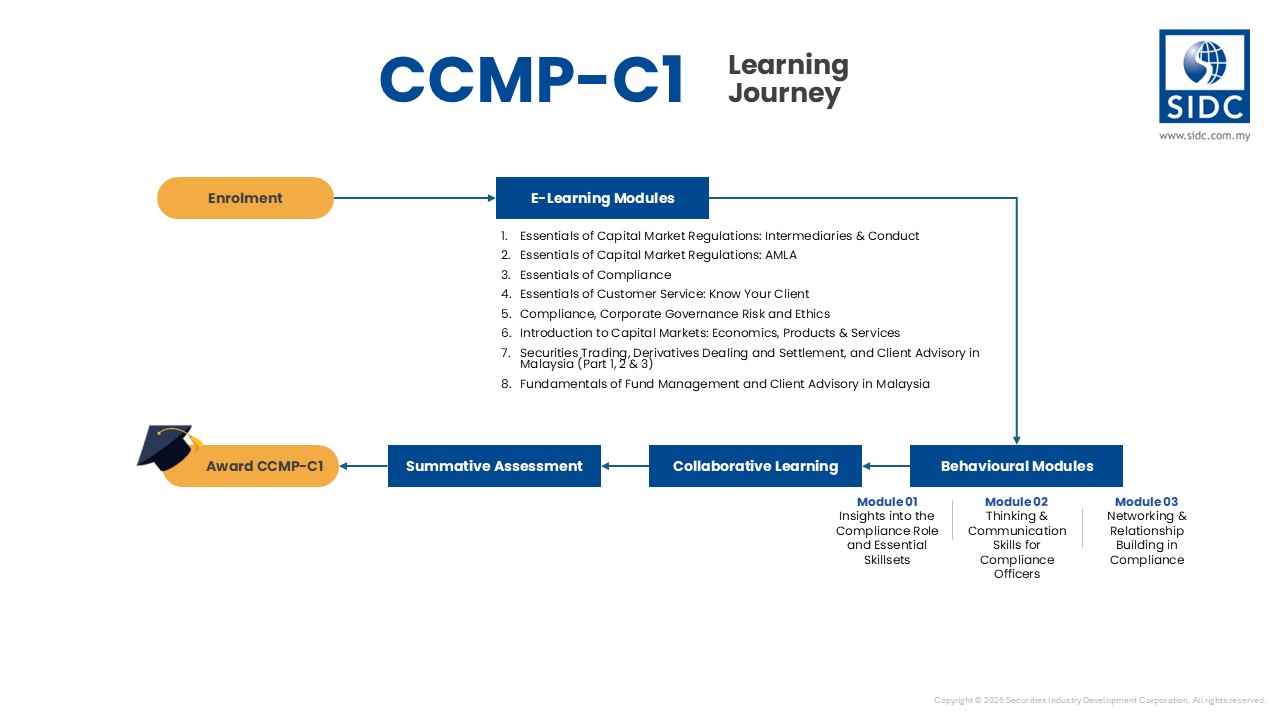
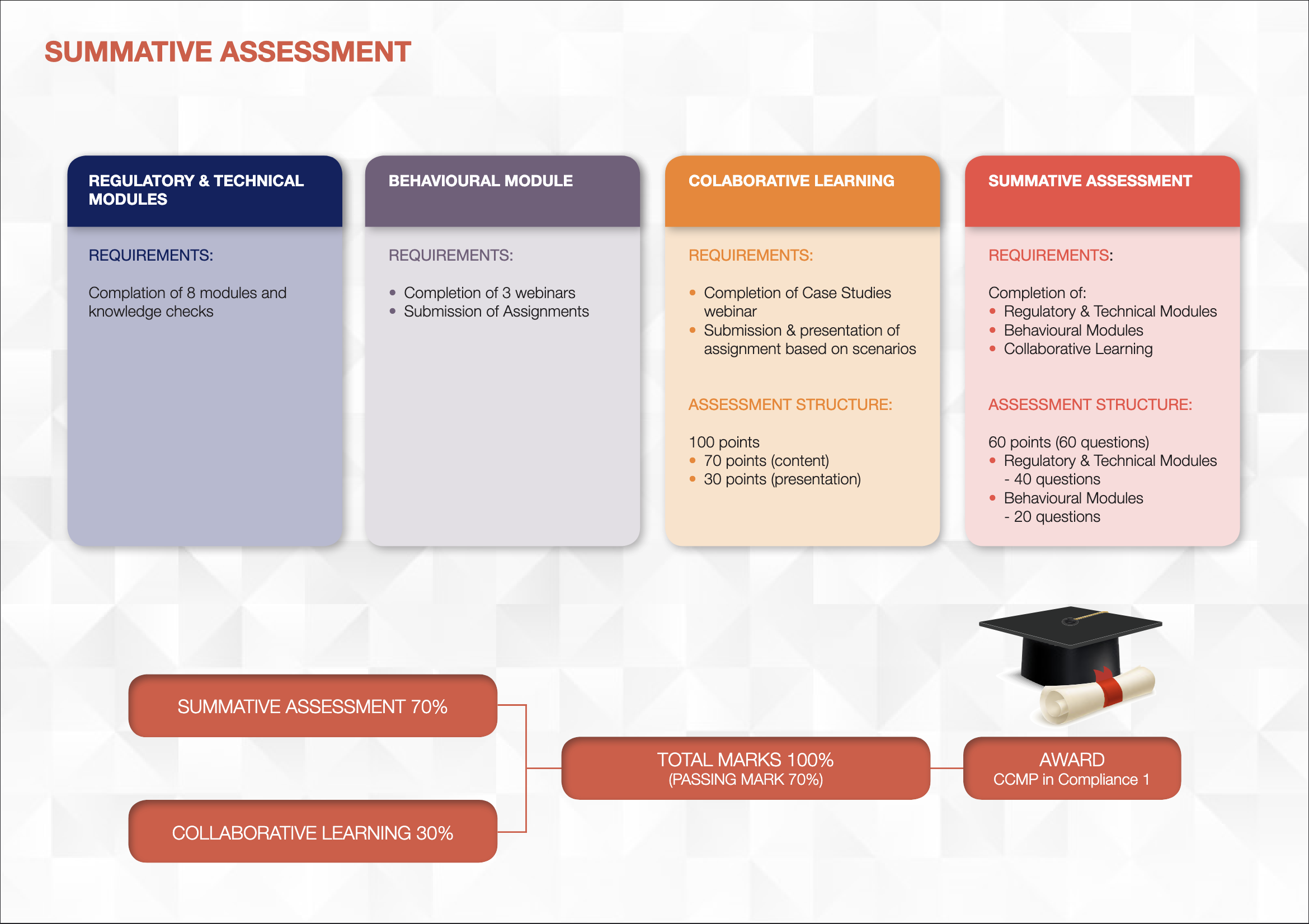
The Certified Capital Market Professional (CCMP) Compliance 1 is conducted online through SIDC’s Learning and Assessment Management (LAMS) platform and comprises the following three (3) components:
- eLearning and Knowledge Checks (Regulatory, Technical and Behavioural Modules)
- Webinars (Collaborative Learning case studies, scenarios and presentation)
- Online Summative Assessment (Scheduled and Remote-proctored)
- CC01 Customer Focus
- CC02 Ethics and Integrity
- CC03 Corporate Governance
- CC04 Risk Management
- FOR01 Anti-Money Laundering
- FOR02 Capital Market Institutions
- FOR03 Capital Market Intermediaries
- FOR04 Capital Market Products Regulations
- FOP01 Capital Market Environment
- FOP03 Capital Market Products
- FUP03 Compliance
- FUP06 Derivatives Dealing
- FUP09 Fund Management
- FUP14 Know Your Client
- FUP16 Securities Trading
- FUP17 Settlement of Derivatives Deals
- FUP18 Settlement of Securities Trades
- FUT02 Client Advisory (Investment)
- FUT04 Digital Technology Application
- BPM01 Communication
- BPM04 Networking and Relationship Building
ENTRY REQUIREMENTS
- Possess a degree / professional qualification from a recognised institution; or
- Possess a diploma from a recognised institution with a minimum 3 years of relevant capital market experience
- For CCMP certifications, you must be at least 21 years old, which is in line with the requirements for a Capital Market Services Representative’s License. The age requirement does not apply for those pursuing modular learning.
DURATION OF MODULES
Estimated duration to complete – Up to 4 months
TARGET AUDIENCE
For aspiring Compliance professionals and all employees in the capital market. Covers essential Compliance concepts, functions, approaches, tools, and skill sets related to capital market laws, principles, and regulatory requirements, technical areas, and general activities of intermediaries.
COMPLETION REQUIREMENTS
Candidates must have completed and passed the CCMP in Compliance 1 Learning and Assessment.
Module 1: Essentials of Capital Market Regulations: Intermediaries and Conduct
| Recommended learning hours | 30 minutes |
| Overview | This course primarily provides an overview of the Malaysian capital market, touching on the various capital market laws and regulations, explaining in detail roles and functions of the entities involved in the capital market (regulators and intermediaries), the rules and regulations applicable to the various regulated activities, function of capital raising, trading, and dealing and the types of offences related to market misconduct and the prohibited conducts. |
| Learning Outcomes | Upon completion of this programme, participants will be able to:
|
| Topics | This module will cover:
|
Module 2: Essentials of Capital Market Regulations: AMLA
| Recommended learning hours | 30 minutes |
| Overview | This course provides participants with an overview of AMLA, its importance and its management to meet legal and regulatory requirements and expectations. It will also enhance participants’ ability to apply appropriate measures to mitigate the money laundering and financing risk in the compliance function. |
| Learning Outcomes | Upon completion of this programme, participants will be able to:
|
| Topics | This module will cover:
|
Module 3: Essentials of Compliance
| Recommended learning hours | 30 minutes |
| Overview | This course primarily provides an overview on the concept and importance of compliance, the roles and responsibilities of different parties within a firm in relation to compliance, the functions of compliance officers which include providing advisory, compliance review, conducting or assist in conducting compliance training programme and developing a compliance programme. The course also covers compliance issues including the impact of technology on the compliance role. |
| Learning Outcomes | Upon completion of this programme, participants will be able to:
|
| Topics | This module will cover:
|
Module 4: Essentials of Customer Service: Know Your Client
| Recommended learning hours | 30 minutes |
| Overview | This course will introduce participants to the concept of effective customer service ranging from customer focus, sales & marketing and know your client and the role of compliance. |
| Learning Outcomes | Upon completion of this programme, participants will be able to:
|
| Topics | This module will cover:
|
Module 5: Compliance, Corporate Governance, Risk and Ethics
| Recommended learning hours | 30 minutes |
| Overview | This course will provide participants with an introduction on the relevance of corporate governance, risk management and ethics & integrity to compliance in the Malaysian capital market. Participants will be exposed to recommended practices of corporate governance, the identification of risk management practices in organisations, the concept and principles of ethics and integrity in relation to overall compliance for the capital market. |
| Learning Outcomes | Upon completion of this programme, participants will be able to:
|
| Topics | This module will cover:
|
Module 6: Introduction to Capital Markets: Economics, Products and Services
| Recommended learning hours | 30 minutes |
| Overview | This course provides an overview of economics, capital market environment, types of the capital market products such as equities, fixed income, derivatives, hybrid securities as well as the money market instrument. The concept of time value of money and basic finance theories will be introduced to gain an understanding on risk and return of capital market products. |
| Learning Outcomes | Upon completion of this programme, participants will be able to:
|
| Topics | This module will cover:
|
Module 7 (Part 1) : Securities Trading, Derivatives Dealing and Settlements And Client Advisory In Malaysia
| Recommended learning hours | 15 minutes |
| Overview | This course provides an overview on securities trading and derivatives dealing and settlement in Malaysia, the regulations, the process of trading and dealing in securities and derivatives, dealing with client and the advisory function in relation to dealing in securities and derivatives. This course provides an overview on the regulations and processes related to dealing in securities and derivatives in Malaysia, ranging from advising clients to trading and settlement |
| Learning Outcomes | Upon completion of this programme, participants will be able to:
|
| Topics | This module will cover:
|
Module 7 (Part 2) : Securities Trading, Derivatives Dealing and Settlements And Client Advisory In Malaysia
| Recommended learning hours | 15 minutes |
| Overview | This course provides an overview on securities trading and derivatives dealing and settlement in Malaysia, the regulations, the process of trading and dealing in securities and derivatives, dealing with client and the advisory function in relation to dealing in securities and derivatives. This course provides an overview on the regulations and processes related to dealing in securities and derivatives in Malaysia, ranging from advising clients to trading and settlement |
| Learning Outcomes | Upon completion of this programme, participants will be able to:
|
| Topics | This module will cover:
|
Module 7 (Part 3) : Securities Trading, Derivatives Dealing and Settlements And Client Advisory In Malaysia
| Recommended learning hours | 15 minutes |
| Overview | This course provides an overview on securities trading and derivatives dealing and settlement in Malaysia, the regulations, the process of trading and dealing in securities and derivatives, dealing with client and the advisory function in relation to dealing in securities and derivatives. This course provides an overview on the regulations and processes related to dealing in securities and derivatives in Malaysia, ranging from advising clients to trading and settlement |
| Learning Outcomes | Upon completion of this programme, participants will be able to:
|
| Topics | This module will cover:
|
Module 8: Fundamentals of Fund Management and Client Advisory in Malaysia
| Recommended learning hours | 30 minutes |
| Overview | This course covers the fundamentals in relation to fund management from the rules and regulations applicable to fund management companies to the various theories and methods used for the construction of investment portfolios for clients. |
| Learning Outcomes | Upon completion of this programme, participants will be able to:
|
| Topics | This module will cover:
|
Modules
Insights into the Compliance Role and Essential Skillsets
| Overview | The changes in today’s regulatory and business environments demands different skills on compliance officers. There is a pressing need to upgrade their skills and influence to manage the ever evolving regulatory changes in the increasingly competitive business landscape. This course provides comprehensive, practical insights and strategies in enhancing the behavioural skills relevant to participants starting out as compliance officers in the capital market. This course focuses on the practical strategies in demonstrating the essential behavioural skills to enable them to discharge their functional and advisory roles effectively |
| Objective | This programme will enable participants to recommend an action plan to mitigate compliance issues while anticipating challenges from the business units and communicate with the regulator. |
| Learning Outcomes | By the end of this programme, participants will be able to:
|
| Target Audience |
|
| Registration |
Overview of Compliance Role and Functions
|
| Screen Break |
Essential Skillsets of Compliance Officers
|
| Lunch |
Compliance in Action
|
| Screen Break |
Implementing the Action Plan
|
| End of Programme |
Thinking and Communication Skills for Compliance Officers
| Overview | The key roles Compliance Officers need to focus on are advising, educating and monitoring. Practical skills necessary to carry out the compliance function effectively are thinking and communication skills to interact with all levels of the organisation. This course focuses on participants embarking on the compliance function where they will be exposed to problem solving approaches which would be useful in their roles and responsibilities. Participants will also be able to convey ideas and information by applying the communication process to ensure clarity, persuasiveness and confidence. |
| Objective | This programme will enable participants to recommend a solution for a problem or issue supported by possible options in a given situation related to the compliance function |
| Learning Outcomes | By the end of this programme, participants will be able to:
|
| Target Audience |
|
| Registration |
Thinking Frameworks and Fundamentals
|
| Screen Break |
Essentials of Problem Solving and Decision Making
|
| Lunch |
Communication for Better Workplace Efficiency
|
| Screen Break |
Managing Effective Compliance Conversations
|
| End of Programme |
Networking and Relationship Building in Compliance
| Overview | The compliance unit is essential in any capital market intermediary as it serves to ensure that everyone working in the capital market intermediary adheres to laws and regulation. In order to carry out its function effectively, the compliance unit should establish a strong network and relationship with internal and external parties to ensure the smooth running of the business at the same time comply with laws and regulations. The course will enable participants to create networking opportunities and build relationships with both internal and external parties to enable meaningful conversations on compliance to be carried out. This course introduces techniques and strategies to build confidence in networking among various stakeholders. Participants will take part in discussions, interactive tasks and role plays to immediately put into practice the techniques and strategies taught. |
| Objective | Participants will be able to build effective networks between compliance unit and various stakeholders and avoid the common pitfalls when building business relationships. |
| Learning Outcomes | By the end of this programme, participants will be able to:
|
| Target Audience |
|
| Registration |
Essentials of Networking
|
| Screen Break |
Building Effective Networking
|
| Lunch |
Expanding and Strengthen Network
|
| Screen Break |
Making Effective Stakeholder Engagement
|
| End of Programme |
eLearning Course
| PROGRAMME NAME | REGISTRATION END DATE | FEE (RM) | REGISTRATION LINK |
|---|---|---|---|
| Essentials of Compliance (formerly known as CCMP in C1 eLearning Package) | All Year Long | 550.00 | Register Here |
Webinar (inc. Certificate)
The CCMP in Compliance 1’s E-Learning and Webinars are available as standalone packages. Register for the complete CCMP in Compliance 1 programme to earn the CCMP certification.| PROGRAMME NAME | REGISTRATION END DATE | ASSESSMENT | SCHEDULE | FEE (RM) | REGISTRATION LINK |
|---|---|---|---|---|---|
| CCMP–C1 (Intake 1/2026) | 30 April 2026 | 18 June 2026 10.00am – 11.30am | View Here | 3,800.00 | Register Here |
| 18 June 2026 2.30pm – 4.00pm | Register Here |