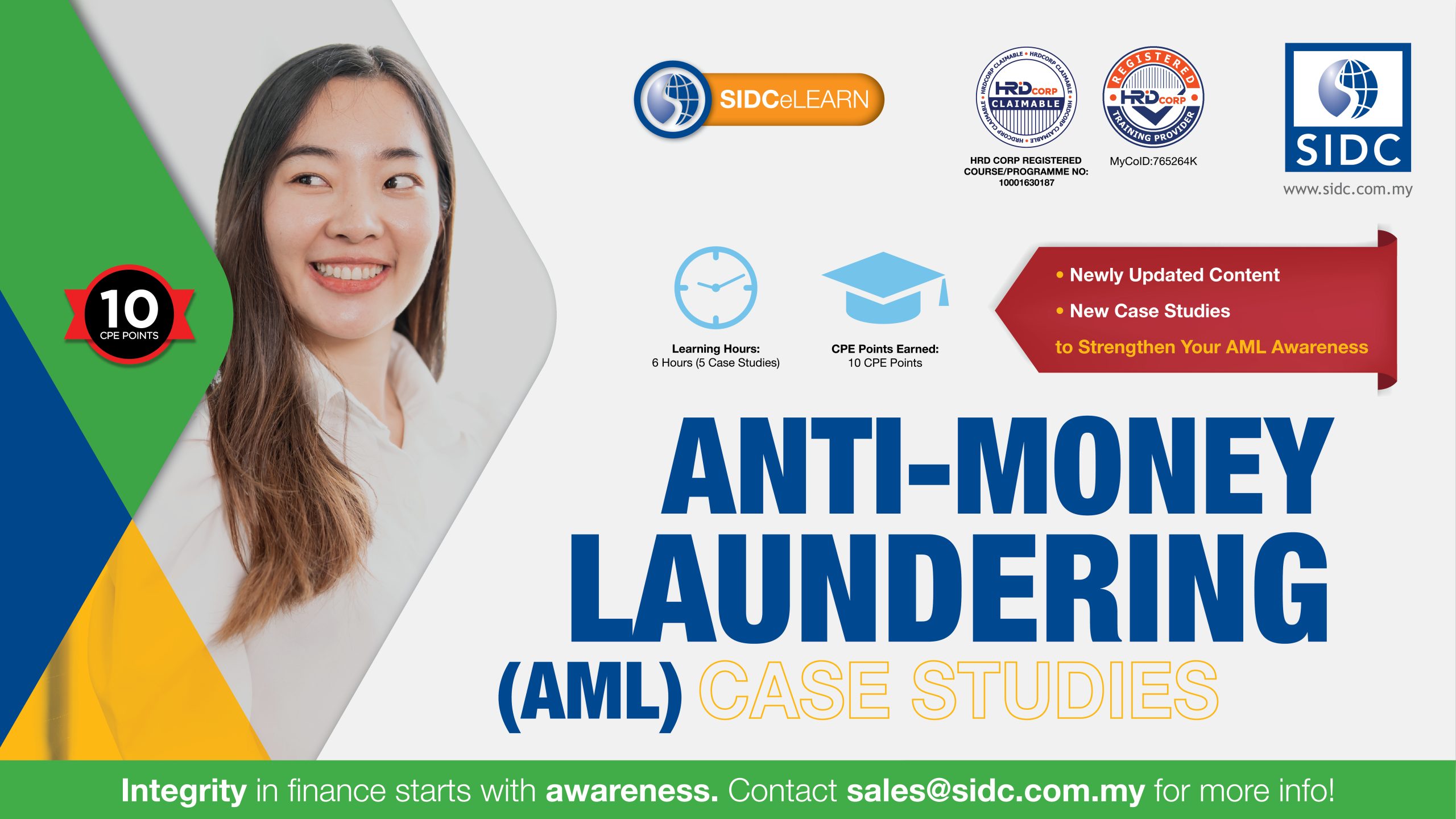
 This e-learning programme presents a series of five real-world case studies that demonstrate the importance of effective compliance systems in the financial sector. Each case explores distinct themes such as regulatory breaches, gatekeeper responsibilities, financial fraud, and AML/CFT control failures. To support effective learning, the series includes short assessments that reinforce key concepts and encourage practical application. Through these scenarios, participants will gain actionable insights into the challenges of non-compliance and develop the skills needed to foster a strong compliance culture.

SIDC Multiportal Mobile
Anti-Money Laundering (AML) – Case Studies
 10 Points
 10001630187
×
Price Listing
RM 750
Excluding 8% SST
Terms & ConditionsAsk a consultant
Have questions?
Our dedicated team of specialists are here to help you!
Get in touch and speak to our friendly team:
Our Team |
[email protected] | +603-6204 8941
or find us on:
Normal Price
Online
365 days
Jan 1, 2026 - Dec 31, 2026
RM 750
Excluding 8% SST
Ask a consultant
Have questions?
Our dedicated team of specialists are here to help you!
Get in touch and speak to our friendly team:
Our Team |
[email protected] | +603-6204 8941
or find us on:
Normal Price
Online
365 days
Jan 1, 2026 - Dec 31, 2026
Ratings: 0, Trainers: 0, Partners: 0
Overview
This e-learning programme presents a series of five real-world case studies that demonstrate the importance of effective compliance systems in the financial sector. Each case explores distinct themes such as regulatory breaches, gatekeeper responsibilities, financial fraud, and AML/CFT control failures. To support effective learning, the series includes short assessments that reinforce key concepts and encourage practical application. Through these scenarios, participants will gain actionable insights into the challenges of non-compliance and develop the skills needed to foster a strong compliance culture.
Programme Objective
The objective of this programme is to develop participants’ ability to detect, prevent, and mitigate risks
related to money laundering, terrorism financing, and financial misconduct. By engaging with realistic case studies and regulatory insights, participants will build the competencies required to implement effective compliance measures, strengthen AML/CFT frameworks, and uphold regulatory integrity within their organizations.
Learning Outcomes
By the end of this programme, participants will be able to:
• Understand the foundational principles of compliance and its significance in the financial sector.
• Recognize the consequences of weak compliance systems and poor compliance culture.
• Apply regulatory guidelines to transaction processes and account management.
• Appreciate the role of gatekeepers in maintaining compliance standards.
• Identify and prevent financial fraud through vigilance and proper controls.
• Strengthen AML/CFT practices to mitigate risks associated with complex structures and legal persons.
• Embrace continuous improvement in compliance practices.
- Methodology
- Competencies
- Entry Requirements
- Duration of Modules
- Target Audience
- Completion Requirements
Methodology
Methodology
Interactive online learning featuring real-world case studies and regulatory insights.
Competencies
- FOR01 Anti-Money Laundering
- FOR02 Capital Market Institutions
- FUP14 Know Your Client
- FUP05 Data and Records Management
- FUP03 Compliance
Entry Requirements
No Entry Requirements
Duration of Modules
Duration Modules
6 Hours (5 Case Studies)
Target Audience
Target Audience
New hires, new capital market entrants, professionals seeking to enhance their understanding of compliance and AML/CFT practices, employees in front-office functions, Dealer’s Representatives, Derivatives Representatives, Portfolio Managers, Sales and Marketing Executives, Employees of Registered Persons, Compliance Officers, Internal/External Audit Officers, Risk Management Officers, and employees from regulatory and enforcement agencies.
Completion Requirements
No Completion Requirements
Case Studies
1
Case Studies 1
2
Case Studies 2
3
Case Studies 3
4
Case Studies 4
5
Case Studies 5
Case Study 1: The Rocky Road of Compliance
This case explores the consequences of weak compliance systems and poor compliance culture within financial institutions. It focuses on the Securities Commission Malaysia (SC) audit of MyTrust Investment Management Sendirian Berhad (MTIM – a fictitious company). The audit uncovered multiple compliance failures, including inadequate safeguards for clients’ assets, insufficient policies to manage conflicts of interest, and a lack of effective internal controls by the Board of Directors. These findings underscore the potential risks to investors when compliance frameworks are not properly implemented.
The case comprises two main discussions:
- Non-Compliance to SC Guidelines
- Skill, Care and Diligence
- Supervision and Control
- Conflict of Interest
- Safeguarding Clients’ Assets
- Dealing with Regulators
- Compliance Culture
- Administrative Action by the SC
Case Study 2: Beyond a Box Ticking Exercise
This case highlights key compliance failures identified during the SC audit of Cressida Securities Berhad (CRESS – a fictitious company). The audit revealed lapses in client transaction procedures, including account opening, trading limit approvals, and suspicious transaction monitoring. It serves as a basis to explore the impact of weak compliance practices in licensed financial institutions.
Key Discussion Points:
- SC Findings on Transaction
- CRESS Response to SC Audit Findings
- Administrative Action by the SC
- Provision for Legal Action
Case Study 3: Failures of the Gatekeepers
This case explores repeated compliance failures by Akira (Malaysia) Sendirian Berhad (a fictitious company), following audits conducted by the SC. Despite earlier penalties, Akira continued to breach regulatory guidelines, including those related to anti- money laundering and terrorism financing. The case raises critical questions about the effectiveness of internal controls and the role of the Board of Directors in preventing recurring non-compliance.
Key Discussion Points:
- Chronology of Transaction Violation
- Akira’s Review and Action Plan Following SC Audit Findings
- Consequences of Failures at Akira
Case Study 4: Unveiling Financial Fraud – A Deep Dive into 17 Charges
This case examines a high-profile financial misconduct involving Charles Chua Yi Fuan, a former Vice President at Hong Leong Investment Bank. Between 2017 and 2019, Chua exploited his position to deceive investors into subscribing to fictitious investment schemes, resulting in losses totaling RM1.73 million. The case highlights serious breaches of trust and regulatory standards, raising important questions about internal controls, ethical conduct, and investor protection in the financial industry.
Key Discussion Points:
- The Allegations Against Charles Chua
- Investigations: Timeline of Events
- Investors Impact and Legal Safeguards
- Charges and Conviction
Case Study 5: Strengthening AML/CFT Practices in a Singapore-Based Financial Institutions
This case explores Singapore’s proactive approach to combating transnational money laundering and terrorism financing risks. As a global financial hub, Singapore faces heightened exposure to illicit financial flows, often facilitated through legal entities like companies and trusts. In response, the Monetary Authority of Singapore (MAS) issued a guidance paper to help financial institutions strengthen their AML/CFT controls and better detect and mitigate these threats.
Key Discussion Points:
- Detecting and Mitigating AML/CFT Risks in Complex Structures
- Enhancing CDD Effectiveness: Supervisory Observations
- Enhancing AML/CFT Control & Supervisory Expectations
- Strengthening AML/CFT Through Ongoing Monitoring
Ratings: 0, Trainers: 0, Partners: 0