Overview
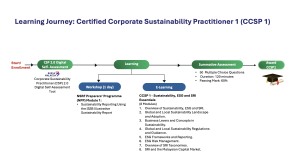
This e-learning programme comprises eight (8) modules that cover the fundamentals of sustainability and ESG (environmental, social, and governance) principles, focusing on the identification and management of ESG risks, as well as their integration into organisational decision-making, operations, and governance in line with Malaysian regulatory requirements, established taxonomies, standards, and best practice.
Objective
The e-learning programme is designed to equip participants with a comprehensive and structured understanding of the fundamentals of sustainability and environmental, social, and governance (ESG) principles. It covers core concepts, regulatory requirements, relevant standards and frameworks, as well as the identification and management of ESG-related risks.
Learning Outcomes
By the end of the e-learning programme, participants will be able to:
- Explain the fundamental concepts and principles of sustainability and environmental, social, and governance (ESG) frameworks within the context of organisational strategy and performance.
- Identify and interpret key regulatory requirements, standards, and frameworks relevant to sustainability and ESG practices in Malaysia and internationally.
- Assess the implications of ESG-related risks and opportunities on organisational decision-making, operations, and governance processes.
- Apply foundational sustainability and ESG knowledge to support the development and implementation of effective sustainability initiatives and reporting practices within their organisations
| Module 1: Overview of Sustainability, ESG and SRI |
| Recommended learning hours |
30 minutes |
| Overview |
This module provides participants a view of the fundamentals of sustainability, ESG and SRI. As one of the fastest growing transformational corporate concepts in decades, sustainability is becoming a top agenda item of many stakeholder groups. This module defines sustainability and its components to support corporations and the financial sector in making this transition. |
| Objective |
At the end of this module, participants will be able to:
- Explain the definitions of environmental, social and governance pillars
- Identify the drivers of sustainability within stakeholder groups such as government, the financial sector, investors, customers, employees and consumers.
- Define the importance and drivers of corporate sustainability
- Discuss the role of sustainable and responsible investments and its role in the capital market
- Describe the impact and importance of sustainability and the link to SRI
|
| Topics |
This module will cover the following:
- Key Reasons for the Widespread Adoption of Sustainability
- Importance and Drivers of Corporate Sustainability
- Definition of Corporate Sustainability and ESG
- Role and Importance of Financial Markets and Players
- Definition and Importance of Sustainable and Responsible Investments (SRI)
|
| ICF |
- Core (Regulatory) – Corporate Governance (Proficiency Level 3)
- Foundational (Product) – Capital Market Regulations (Proficiency Level 3)
- Foundational (Product) – Sustainable and Responsible Investment Products (Proficiency Level 3)
- Functional (Technical) – Sustainability / SRI Analysis (Proficiency Level 3)
|
 Â
|
Module 2: Global and Local Sustainability Landscape and Adoption |
| Recommended learning hours |
30 minutes |
| Overview |
This module provides a view of sustainability developments globally and in Malaysia. It covers key concepts in the environmental, social and governance pillars. The module details a sustainability adoption methodology that can be employed by corporations for a structured transformation. |
| Objective |
At the end of this module, participants will be able to:
- Identify the global and local developments in sustainability and SRI
- Explain key concepts in environmental, social and governance pillars
- Discuss the phases in sustainability adoption methodology
- Apply a corporate sustainability adoption process
|
| Topics |
This module will cover:
- Global and Local Developments in Sustainability
- Global and Local Developments in SRI
- Key Concepts in the Environmental Pillar
- Key Concepts in the Social Pillar
- Key Concepts in the Governance Pillar
- Corporate Sustainability Adoption Methodology
|
| ICF |
- Core (Regulatory) – Corporate Governance (Proficiency Level 3)
- Foundational (Product) – Capital Market Regulations (Proficiency Level 3)
- Foundational (Product) – Sustainable and Responsible Investment Products (Proficiency Level 3)
- Functional (Technical) – Sustainability / SRI Analysis (Proficiency Level 3)
|
| Module 3: Business Levers and Concepts in Sustainability |
| Recommended learning hours |
30 minutes |
| Overview |
This module provides a view of sustainability as a growth strategy; and a review of three opportunity levers for business planning considerations. These three levers can pose a threat or an opportunity and form the basis of the integration of sustainability into core business strategy. |
| Objective |
At the end of this module, participants will be able to:
- Define the three levers of sustainability in business
- Identify sustainability initiatives for the company supporting each pillar
- Apply sustainability into business practices and supply chain
- Describe the fundamentals of carbon markets
|
| Topics |
This module will cover:
- Business Strategies Ranging from Threat to Opportunity
- Lever 1: Reducing Risks
- Lever 2: Maximising Profits
- Lever 3: Unlocking Growth
- Adopting Sustainability in Supply Chains
- Overview of Carbon Credits and Trading
|
| ICF |
- Core (Regulatory) – Corporate Governance (Proficiency Level 3)
- Foundational (Product) – Capital Market Regulations (Proficiency Level 3)
- Foundational (Product) – Sustainable and Responsible Investment Products (Proficiency Level 3)
- Functional (Technical) – Sustainability / SRI Analysis (Proficiency Level 3)
|
| Module 4: Global and Local Sustainability Regulations and Guidance​ |
| Recommended learning hours |
30 minutes |
| Overview |
This module provides a view of global and local regulations including the European Union (EU), the United States (US) and Malaysia, as well as a detailed review of disclosure guidance from Securities Commission Malaysia (SC), Bank Negara Malaysia (BNM) and Bursa Malaysia.
|
| Objective |
At the end of this module, participants will be able to:
- Explain the importance of global notable ESG regulations
- Describe the Malaysian regulatory landscape and its disclosure regulations and guidance
- Recognise the regulator’s role in driving Malaysia’s sustainable development, SRI and ESG
- Discuss the impact of sustainability regulation and standards on capital market players
|
| Topics |
This module will cover:
- Overview of Global Regulations (EU CSRD, SFDR and CBAM, US SEC)
- Malaysian Regulations
- Disclosure Regulations and Guidance from Securities Commission Malaysia (CMP3, SRI Roadmap, Guidelines of SRI Funds, SEDG, MCCG, SRI Sukuk Framework, Islamic Fund and Wealth Management Blueprint) (SRI Taxonomy is covered in a later module)
- Disclosure Regulations and Guidance from Bank Negara Malaysia (Climate Risk Management and Scenario Analysis (CRMSA), TCFD Application Guide, Climate Risk Stress Testing (CRST), Value-Based Intermediation (VBI, Financial Sector Blueprint) (CCPT is covered in a later module)
- Disclosure Regulations and Guidance from Bursa Malaysia (Amended Listing Requirements, FTSE4Good Evaluation)
|
| ICF |
- Core (Regulatory) – Corporate Governance (Proficiency Level 3)
- Foundational (Product) – Capital Market Regulations (Proficiency Level 3)
- Foundational (Product) – Sustainable and Responsible Investment Products (Proficiency Level 3)
- Functional (Technical) – Sustainability / SRI Analysis (Proficiency Level 3)
|
Â
| Module 5: ESG Measurement and Reporting |
| Recommended learning hours |
30 minutes |
| Overview |
This module provides a view of ESG data requirements, tracking, disclosure, evaluation and rating; and a detailed review of scoring by rating agencies. This will enable participants to make an informed decision on the selection, disclosure and evaluation of an organisation’s sustainability disclosures.
|
| Objective |
At the end of this module, participants will be able to:
- Explain the importance, benefits and challenges of ESG reporting,
- Describe the components of ESG data management framework
- Differentiate ESG reporting and evaluation frameworks
- Apply appropriate ESG reporting frameworks within an organisation
|
| Topics |
This module will cover:
- Importance of ESG Reporting
- Benefits and Challenges of ESG Reporting
- ESG Data Management and Technology
- Selected ESG Reporting Frameworks
- Selected ESG Evaluation Frameworks
- Selected Environmental Frameworks
- Selected Social Frameworks
|
| ICF |
- Core (Regulatory) – Corporate Governance (Proficiency Level 3)
- Foundational (Product) – Capital Market Regulations (Proficiency Level 3)
- Foundational (Product) – Sustainable and Responsible Investment Products (Proficiency Level 3)
- Functional (Technical) – Sustainability / SRI Analysis (Proficiency Level 3)
|
| Module 6: ESG Risk Management |
| Recommended learning hours |
30 minutes |
| Overview |
This module provides a view of the significance of ESG risk globally and the relevant frameworks to leverage. It provides a general risk framework and discusses the implications of greenwashing. |
| Objective |
At the end of this module, participants will be able to:
- Describe the importance of ESG risk management
- Explain the application of ESG risk globally
- Distinguish ESG risk management tools in various key frameworks
- Analyze the intricacies of greenwashing and its implications
|
| Topics |
This module will cover:
- Importance of ESG Risk Management
- ESG Risk Management Global Guidance
- ESG Risk Management in ISSB
- ESG Risk Management in FTSE4Good
- ESG Risk Management in UNPRI
- ESG Risk Management Framework
- Overview of Greenwashing
- Greenwashing Illustrations
|
| ICF |
- Core (Regulatory) – Corporate Governance (Proficiency Level 3)
- Core (Regulatory) - Risk Management (Level 3)
- Foundational (Product) – Capital Market Regulations (Proficiency Level 3)
- Foundational (Product) – Sustainable and Responsible Investment Products (Proficiency Level 3)
- Functional (Technical) – Sustainability / SRI Analysis (Proficiency Level 3)
|
| Module 7: Overview of SRI Taxonomies |
| Recommended learning hours |
30 minutes |
| Overview |
This module provides a view of global and local SRI taxonomies and how they serve different parties in the alignment of commercial activities. It covers the different taxonomies and presents the underpinning principles. The module also provides guiding steps to help apply a chosen taxonomy.
|
| Objective |
At the end of this module, participants will be able to:
- Describe the function and importance of standardised taxonomies
- Identify the variances of principles and definitions in taxonomies (EU Taxonomy, ASEAN Taxonomy, SRI Taxonomy, Climate Change Principles-based Taxonomy)
- Apply the principles of taxonomy to conclude activity classifications
|
| Topics |
This module will cover:
- Objectives of Sustainability Taxonomies
- Importance of a Unified Taxonomy
- EU Taxonomy
- ASEAN Taxonomy
- Securities Commission Malaysia’s SRI Taxonomy (Environmental, Social, Sustainability Components)
- Bank Negara Malaysia’s Climate Change Principles-based Taxonomy
- Application of an SRI taxonomy
|
| ICF |
- Core (Regulatory) – Corporate Governance (Proficiency Level 3)
- Foundational (Product) – Capital Market Regulations (Proficiency Level 3)
- Foundational (Product) – Sustainable and Responsible Investment Products (Proficiency Level 3)
- Functional (Technical) – Sustainability / SRI Analysis (Proficiency Level 3)
|
Â
| Module 8: SRI and the Malaysian Capital Market |
| Recommended learning hours |
30 minutes |
| Overview |
This module provides a view of the varying structures of capital markets in Malaysia, the range of ESG investment approaches, the different types of products and the structuring process and considerations. |
| Objective |
At the end of this module, participants will be able to:
- Describe the nuances of the capital market ecosystem spanning SRI markets, the Islamic capital market and the Malaysian capital market
- Explain the 5 different types of ESG investment approaches and types of sustainable investments
- Identify key considerations to integrate ESG in structuring SRI products      Â
|
| Topics |
This module will cover:
- Overview of SRI Markets
- Overview of the Islamic Capital Market
- Overview of Malaysian Capital Market
- Capital Market Players and Roles
- ESG Investment Approaches
- Types of Sustainable Investments
- Structuring of SRI Products
- ESG in Multi-Asset Portfolio
- Practical ESG Considerations in a Portfolio
|
- ICF
|
- Core (Regulatory) – Corporate Governance (Proficiency Level 3)
- Foundational (Product) – Capital Market Regulations (Proficiency Level 3)
- Foundational (Product) – Capital Market Fundamentals (Proficiency Level 3)
- Foundational (Product) – Sustainable and Responsible Investment Products (Proficiency Level 3)
- Functional (Technical) – Sustainability / SRI Analysis (Proficiency Level 3)
|