For Compliance professionals with relevant experience looking to further upskill their competencies to be more effective as a Compliance officer.

SIDC Multiportal Mobile
Certified Capital Market Professional (CCMP) in Compliance 2

 10001501900
×
Price Listing
RM 4800 (AM Session)
Excluding 8% SST
Terms & ConditionsAsk a consultant
Have questions?
Our dedicated team of specialists are here to help you!
Get in touch and speak to our friendly team:
Our Team |
[email protected] | +603-6204 8941
or find us on:
Normal Price
Online
1 day
Nov 26, 2025
RM 4800 (PM Session)
Excluding 8% SST
Terms & ConditionsAsk a consultant
Have questions?
Our dedicated team of specialists are here to help you!
Get in touch and speak to our friendly team:
Our Team |
[email protected] | +603-6204 8941
or find us on:
Group Discount
Online
1 day
Nov 26, 2025
RM 4800 (AM Session)
Excluding 8% SST
Ask a consultant
Have questions?
Our dedicated team of specialists are here to help you!
Get in touch and speak to our friendly team:
Our Team |
[email protected] | +603-6204 8941
or find us on:
Normal Price
Online
1 day
Nov 26, 2025
RM 4800 (PM Session)
Excluding 8% SST
Ask a consultant
Have questions?
Our dedicated team of specialists are here to help you!
Get in touch and speak to our friendly team:
Our Team |
[email protected] | +603-6204 8941
or find us on:
Group Discount
Online
1 day
Nov 26, 2025
Ratings: 0, Trainers: 0, Partners: 0


Certified Capital Market Professional (CCMP) in Compliance 2 is designed for compliance professionals with relevant experience looking to further upskill their competencies to be more effective as a compliance officer.
- Methodology
- Competencies
- Entry Requirements
- Duration of Modules
- Target Audience
- Completion Requirements
Methodology
METHODOLOGY
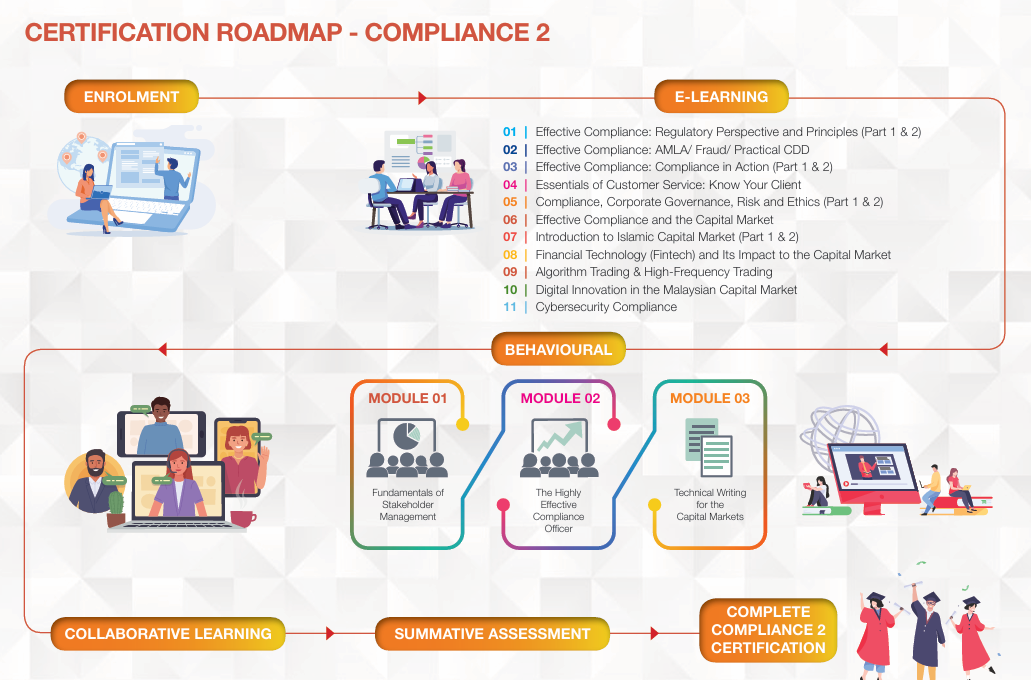
- eLearning and Knowledge Checks (Regulatory, Technical and Behavioural Modules)
- Webinars (Collaborative Learning case studies, scenarios and presentation)
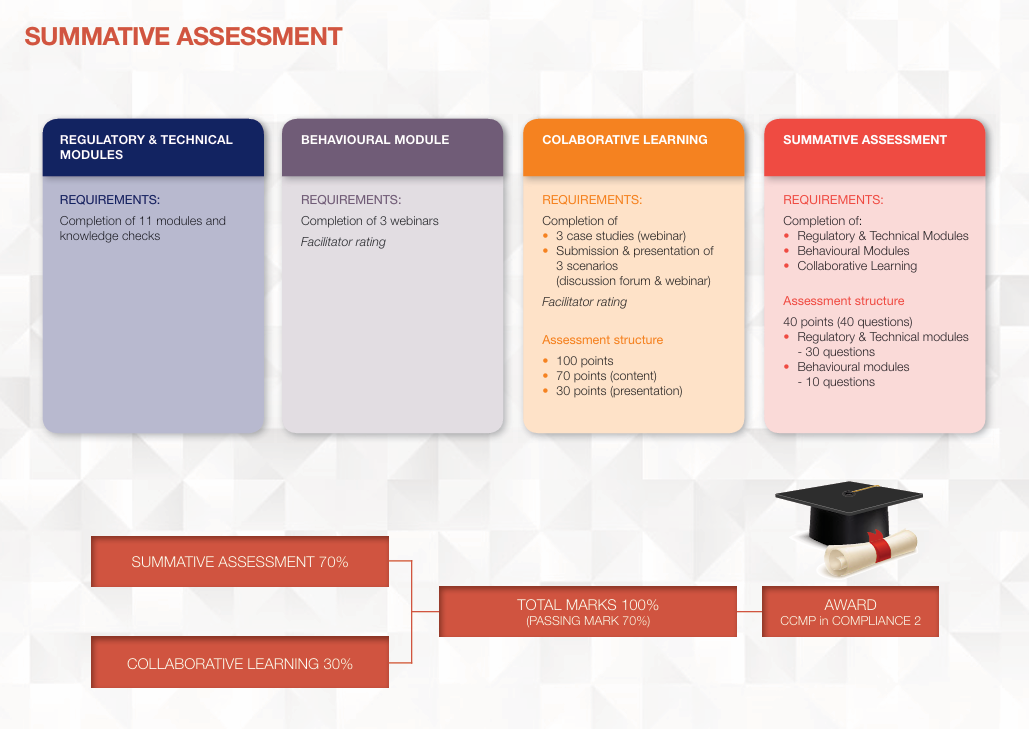
- Online Summative Assessment (Scheduled and Remote-proctored)
Competencies
Entry Requirements
ENTRY REQUIREMENT
- CCMP-C1 holder; OR
- Practitioner performing compliance function with >2 years relevant experience within financial services (Job title need not be “Compliance Officer”)
Duration of Modules
DURATION OF MODULES
Estimated duration to complete – up to 4 Months
Target Audience
TARGET AUDIENCE
Completion Requirements
COMPLETION REQUIREMENT
Completed and passed CCMP-C2 learning and assessment
This eLearning programme aims to strengthen and upskill the functional competencies of compliance professionals to be more effective as compliance officers.
1
Module 1
2
Module 2
3(I)
Module 3(I)
3(II)
Module 3(II)
5(I)
Module 5(I)
5(II)
Module 5(II)
6
Module 6
7(I)
Module 7(I)
7 (II)
Module 7 (II)
8
Module 8
9
Module 9
10
Module 10
11
Module 11
Module 1
| Module 1: Effective Compliance: Regulatory Perspective and Principles - Part 1 | |
| Recommended learning hours | 15 minutes |
| Overview | This course provides a comprehensive overview of the capital market regulatory principles which emphasises fit and proper conduct and the compliance culture as an organisational obligation. The course further provides insights on the regulatory expectations on compliance where participants will learn to balance the interests of regulators and the firm. The distinct roles of the business, compliance and internal audit in managing risk to operate effectively, the duties, responsibilities and best practices for audit and inspection. Participants will also learn of the current regulatory and compliance challenges in terms of disruptors and the digital future. |
| Learning Outcomes | Upon completion of this programme, participants will be able to:
|
| Topics | This module will cover:
|
| ICF |
|
| Module 1: Effective Compliance: Regulatory Perspective and Principles - Part 2 | |
| Recommended learning hours | 15 minutes |
| Overview | This course provides a comprehensive overview of the capital market regulatory principles which emphasises fit and proper conduct and the compliance culture as an organisational obligation. The course further provides insights on the regulatory expectations on compliance where participants will learn to balance the interests of regulators and thte firm. The distinct roles of the business, compliance and internal audit in managing risk to operate effectively, the duties, responsibilities and best practices for audit and inspection. Participants will also learn of the current regulatory and compliance challenges in terms of disruptors and the digital future. |
| Learning Outcomes | Upon completion of this programme, participants will be able to:
|
| Topics | This module will cover:
|
| ICF |
|
Module 2
| Module 2: Effective Compliance: AMLA/Fraud/Practical CDD | |
| Recommended learning hours | 30 minutes |
| Overview | The course provides participants with the strategies and tools to detect and prevent the increasingly complex money laundering, fraud and terrorism activities undertaken by the perpetrators while taking into account the risk profile, regulatory obligations and the legal framework. This course covers contemporary issues on AML, fraud and terrorism financing including the latest regulatory approaches and insights on how the compliance could support the organisations to combat money laundering through the use of new risk management strategies and the use of latest technology. |
| Learning Outcomes | Upon completion of this programme, participants will be able to:
|
| Topics | This module will cover:
|
| ICF |
|
Module 3(I)
| Module 3: Effective Compliance: Compliance in Action - Part 1 | |
| Recommended learning hours | 15 minutes |
| Overview | This course provides participants with the requisite knowledge and skills to effectively apply the compliance principles and concepts and carry out the core functions, primarily focusing on integrated risk management, CDD, monitoring and assessment to the advisory functions and the development of a compliance programme that includes focus on the culture of compliance. |
| Learning Outcomes | Upon completion of this programme, participants will be able to:
|
| Topics | This module will cover:
|
| ICF |
|
Module 3(II)Module 3: Effective Compliance: Compliance in Action - Part 2 |
|
| Recommended learning hours | 15 minutes |
| Overview | This course provides participants with the requisite knowledge and skills to effectively apply the compliance principles and concepts and carry out the core functions, primarily focusing on integrated risk management, CDD, monitoring and assessment to the advisory functions and the development of a compliance programme that includes focus on the culture of compliance. |
| Learning Outcomes | Upon completion of this programme, participants will be able to:
|
| Topics | This module will cover:
|
| ICF |
|
Module 5(I)
| Module 5: Compliance, Corporate Governance Risk and Ethics - Part 1 | |
| Recommended learning hours | 30 minutes |
| Overview | This course will provide participants with the knowledge and skills in carrying out their duties as a capital market professional in relation to corporate governance practices, risk management in the context of compliance and ethical practices. |
| Learning Outcomes | Upon completion of this programme, participants will be able to:
|
| Topics | This module will cover:
|
| ICF |
|
Module 5(II)
| Module 5: Compliance, Corporate Governance Risk and Ethics - Part 2 | |
| Recommended learning hours | 30 minutes |
| Overview | This course will provide participants with the knowledge and skills in carrying out their duties as a capital market professional in relation to corporate governance practices, risk management in the context of compliance and ethical practices. |
| Learning Outcomes | Upon completion of this programme, participants will be able to:
|
| Topics | This module will cover:
|
| ICF |
|
Module 6
| Module 6: Effective Compliance and the Capital Market | |
| Recommended learning hours | 15 minutes |
| Overview | This course provides understanding and application on the concepts of strategy, finance, marketing and operations in the capital market and aligns these with changes occurring in business, social-political, environment and technology; to build successful sustainability-driven ventures that creates value for multiple stakeholders in the capital market particularly from the compliance standpoint. |
| Learning Outcomes | Upon completion of this programme, participants will be able to:
|
| Topics | This module will cover:
|
| ICF |
|
Module 7(I)
| Module 7: Introduction to Islamic Capital Market – Part 1 | |
| Recommended learning hours | 15 minutes |
| Overview | This course focuses on Islamic Capital Market (ICM) principles and concepts and products available in the Malaysian market from Shariah compliant equities to Islamic Structured products. Particular emphasis is given to the case of the Malaysian market, although some international context is mentioned, for added knowledge. Specific examples, illustrations, facts and statistics are given, so participants are informed on the current state of the art. |
| Learning Outcomes | Upon completion of this programme, participants will be able to:
|
| Topics | This module will cover:
|
| ICF | Foundational (Product) – Islamic Capital Market Products (L3) |
Module 7 (II)
| Module 7: Introduction to Islamic Capital Market – Part 2 | |
| Recommended learning hours | 15 minutes |
| Overview | This course focuses on Islamic Capital Market (ICM) principles and concepts and products available in the Malaysian market from Shariah compliant equities to Islamic Structured products. Particular emphasis is given to the case of the Malaysian market, although some international context is mentioned, for added knowledge. Specific examples, illustrations, facts and statistics are given, so participants are informed on the current state of the art. |
| Learning Outcomes | Upon completion of this programme, participants will be able to:
|
| Topics | This module will cover:
|
| ICF | Foundational (Product) – Islamic Capital Market Products (L3) |
Module 8
| Module 8: Financial Technology (FinTech) and Its Impact to the Capital Market | |
| Recommended learning hours | 30 minutes |
| Overview | This course provides an introduction to FinTech developments, the link to RegTech and SupTech and how it promotes a conducive capital market landscape through the development of a holistic FinTech ecosystem. It will also focus on the fundamentals of FinTech, key technological drivers, and cybersecurity threats in building a strong and vibrant FinTech ecosystem. |
| Learning Outcomes | Upon completion of this programme, participants will be able to:
|
| Topics | This module will cover:
|
| ICF |
|
Module 9
| Module 9: Algorithm Trading & High-Frequency Trading | |
| Recommended learning hours | 30 minutes |
| Overview | This course provides an introduction to algorithmic and high-frequency trading (HFT), how HFT is executed and the future challenges of trading while maintaining resilience. |
| Learning Outcomes | Upon completion of this programme, participants will be able to:
|
| Topics | This module will cover:
|
| ICF |
|
Module 10
| Module 10: Digital Innovation in the Malaysian Capital Market | |
| Recommended learning hours | 30 minutes |
| Overview | This course provides insights on the digital initiatives spearheaded by the Securities Commission Malaysia which include the various frameworks for Digital Investment Management (DIM), alternative funding platforms, the Digital Asset Exchanges (DAX), the Initial Exchange Offerings (IEO) and the Digital Asset Custodians (DAC). Discussions at this programme will also include the impact the initiatives bring to the capital market value chain and how one should flexibly adapt and respond to the changes in doing business differently. |
| Learning Outcomes | Upon completion of this programme, participants will be able to:
|
| Topics | This module will cover:
|
| ICF |
|
Module 11
| Module 11: Cybersecurity Compliance | |
| Recommended learning hours | 30 minutes |
| Overview | This course provides overview and the context when it comes to cybersecurity compliance as the entity cannot afford to overlook data breaches, security vulnerabilities and other threats as skilled hacker tend to exploit the human factor through successful phishing scams and other type of cyber-attacks. The keyword is awareness as it is understood that the weakest link and cause of breach is due to the human factor. This session will also look into system capabilities and control measures, whilst emphasizing the context of regular testing to ensure effective information security and control environment. |
| Learning Outcomes | Upon completion of this programme, participants will be able to:
|
| Topics | This module will cover:
|
| ICF |
|
Modules
1
Module 1
2
Module 2
3
Module 3
Fundamentals of Stakeholder Management
| Overview | The role of compliance necessitates an awareness of market and business challenges along with associated opportunities that can be derived successfully by engaging with a multitude of stakeholders. This will allow the merging of regulatory expectations, industry knowledge, experience and the needs of stakeholders to effectively execute the compliance function in the organisation. In this course participants will learn how to identify stakeholders, perform stakeholder analysis, and analyse communications plans and organisational requirements. Participants will also learn different methods of stakeholder engagement and when to utilise them to perform the compliance role effectively. One of the perennial issues for the compliance team is balancing their role between board reporting and communications with senior management. This is in addition to communicating horizontally across the organisation, namely keeping communication channels open to drive and foster a compliance-savvy organisation. |
| Objective | This programme will enable compliance professionals to utilise appropriate strategies, influencing and persuasive techniques and communication tools for stakeholder management in managing compliance matters based on their organisations’ strategies and overall objectives. |
| Learning Outcomes | By the end of this programme, participants will be able to:
|
| Target Audience | Individuals For compliance professionals with relevant experience looking to further upskill their competencies to be more effective as a compliance officer Companies Fund management companies, stockbroking firms, investment banks, alternative financing platforms, startups, exchanges, public listed companies |
The Highly Effective Compliance Officer
| Overview | In today’s dynamic and complex regulatory/business landscape, responding to trends and risks necessitates having highly effective compliance officers equipped with the tools and resources to enhance their skills and influence. Compliance officers are integral to the pursuit of an organisation’s business objectives in supporting and empowering the business to achieve them in an ethically and compliant manner as well embedding ethics and compliance within the organisation’s culture. Highly effective compliance officers are able to position themselves and their compliance programmes as an enabler towards successful realisation of the business objectives whilst ensuring and maintaining compliance. This requires a wide-ranging and advanced skillset that includes knowing the business, stakeholder relations, analytical and strategic thinking and engagement and communication with the regulators. |
| Objective | This course covers knowledge and skillsets for compliance professionals with relevant experience looking to further upskill to enhance effectiveness as a compliance officer. This includes going beyond compliance concepts and frameworks by enabling the compliance professionals to take a practical approach to real life issues encountered in discharging their functions, managing the business of the intermediaries and engagement and communication with the regulators. |
| Learning Outcomes | By the end of this programme, participants will be able to:
|
| Target Audience | Individuals For compliance professionals with relevant experience looking to further upskill their competencies to be more effective as a compliance officer Companies Fund management companies, stockbroking firms, investment banks, alternative financing platforms, startups, exchanges, public listed companies |
Technical Writing for the Capital Markets
| Overview | This course primarily provides participants with the techniques to prepare different types of documentation for different purposes according to capital market activities in accordance with regulatory requirements, industry standards and best practices focusing on compliance documentation and reporting. Quality technical writing for compliance purposes requires a deep understanding of how the capital market works, how regulations are administered and updated, how normal business practice are done by the capital market players, and ideas of how compliance are bypassed by perpetrators. This helps to uphold a high standard of capital market compliance, to continue best practices in order to reduce the possibilities of non-compliance. Compliance officers need the ability to interpret the regulation, ability to do their own research, more proactiveness on compliance sensitivity, communication with clear information, and avoid any misleading info. |
| Objective | Participants will be able to prepare different types of documents intended for capital market stakeholders in accordance with regulatory requirements, industry standards and best practices focusing on compliance documentation and reporting. |
| Learning Outcomes | By the end of this programme, participants will be able to:
|
| Target Audience | Individuals For compliance professionals with relevant experience looking to further upskill their competencies to be more effective as a compliance officer Companies Fund management companies, stockbroking firms, investment banks, alternative financing platforms, startups, exchanges, public listed companies |
| Overview | Today’s compliance function is not just about ticking the boxes on a checklist and ensuring that everyone is abiding by laws, rules, and regulations. It’s also about making a positive impact on the organisation and its business through a robust and ethical compliance programme to prevent reputational and economic nightmares. CCMP-C2, Essentials of Compliance: Case Study Series & Communities of Practice (Real-Life Scenarios) will feature real-life case studies and scenarios to discuss and explore the core compliance issues and their implications faced by businesses today. Through discussions participants will deliberate on the approaches taken when faced with similar situations, the rationale behind the decision made, consider the best compliance practices, as well as learn from others within the industry. |
| Objective | This programme is designed to give insights and equip participants in the capital market with an in- depth understanding and approaches to dealing with compliance issues through real-life case studies and scenarios ranging from essential compliance concepts, functions, approaches, tools and skillsets on capital market laws, principles and regulatory requirements, technical areas, and general activities of intermediaries. |
| Learning Outcomes | Upon completion of this e-learning, participants will be able to:
|
1
E-Learning Course
2
Webinar (inc. Certification)
E-Learning Course
The CCMP in Compliance 2’s E-Learning and Webinars are available as standalone packages. They each consist of all the learning modules and webinars of the respective category.| PROGRAMME NAME | REGISTRATION END DATE | FEE (RM) | REGISTRATION LINK |
|---|---|---|---|
| Effective Compliance (formerly known as CCMP in C2) E-Learning Package | All Year Long | 650.00 | Register Here |
Webinar (inc. Certification)
Register for the complete CCMP in Compliance 2 programme to earn the CCMP certification.| PROGRAMME NAME | REGISTRATION END DATE | ASSESSMENT | SCHEDULE | FEE (RM) | REGISTRATION LINK |
|---|---|---|---|---|---|
| CCMP – C2 (Intake 4/2025) | 30 July 2025 | 24 Sept 2025: 10.00am – 11.30am | View Here | 4,800 | Register Here |
| 24 Sept 2025: 2.30pm – 4.00pm | Register Here | ||||
| CCMP – C2 (Intake 5/2025) | 25 Sept 2025 | 26 Nov 2025: 10.00am – 11.30am | View Here | 4,800 | Register Here |
| 26 Nov 2025: 2.30pm – 4.00pm | Register Here |